 |
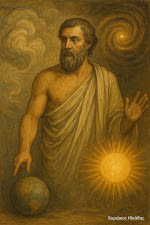
ARISTARCHUS OF SAMOSSamos, 3rd c. BC |
Aristarchus of Samos (3rd century BC) was an ancient Greek astronomer and mathematician, known primarily for his heliocentric theory — one of the most radical ideas in the history of science.
Below is a summary of his "philosophy" or rather his cosmological and scientific thought:
1. Heliocentric System
Aristarchus was the first in history to clearly propose that instead of the sky "moving around us", it is the Earth that moves. This was a profound philosophical breakthrough. This idea was centuries ahead of its time — it reappeared later with Copernicus.
2. Cosmic Distances and Magnitudes
In one of his surviving works, On Magnitudes and Distances, he calculated, although his numerical values were not always accurate (due to lack of technology), his methodology was extremely advanced, he used geometry and observation, not myth or hypothesis.
3. Philosophical Dimensions of His Thought
Aristarchus' "philosophy" was not abstract but scientific-rational. Confidence in geometry and measurement. He believed that celestial truths can be found by calculation and observation, not by traditional concepts.
a. Radical challenge to established cosmology
He challenged the Aristotelian and Ptolemaic Geocentric concept. This also had a philosophical dimension: man is not the center of the universe.
b. Early idea of infinity
If the Earth moves and we do not perceive its movement, then the universe must be enormous, much larger than they thought. This is a philosophical conception of the cosmic scale.
4. Reception of his theory
His contemporaries did not accept the heliocentric theory. The Stoic Cleanthes even suggested that Aristarchus should be accused of impiety, because he "displaced the center of the world".
Aristarchus' philosophy is the first coherent heliocentric view of the world and paved the way for the revolution of modern astronomy.