 |
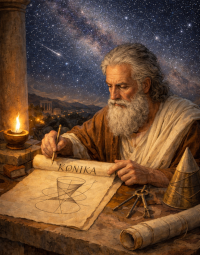
APOLLONIUS OF PERGAPerga, 240 BC - 190 BC |
Apollonius of Perga is one of the most brilliant figures of ancient Greek mathematical thought — and it is not by chance that he was called the “Great Geometer.” The information we have about his life and work comes from historical sources and contemporary analyses.
He lived from approximately 240 BC to 190 BC. He came from Perga in Pamphylia (present-day Turkey). He was a geometer and astronomer of the Alexandrian school.
Apollonius is mainly known for his monumental work “Conics,” in which:
1. He systematized and developed the theory of conic sections.
2. He introduced the terms ellipse, parabola, hyperbola — names that we use to this day.
3. He led geometry to a level that foreshadowed the analytic geometry of Descartes and Newton.
His work influenced Ptolemy in astronomy, the mathematicians of the Islamic Golden Age, and the greats of the Renaissance, such as Newton and Descartes.
One of the most famous problems he posed was the Problem of the Seven Circles, which remained unsolved for centuries until modern times.
Significance of the work in modern science:
Analytic Geometry
Descartes and Fermat (17th century) translated the geometry of Apollonius into algebraic language. The equations: of an ellipse, a parabola, and a hyperbola are a direct continuation of his ideas.
Astronomy & Physics
Kepler's laws: planets move in elliptical orbits
Newtonian gravity: predicts orbits that are conical (ellipse, parabola, hyperbola)
Without the work of Apollonius, this description would not be possible.
Engineering & Technology
Satellite and spacecraft orbits.
Parabolic mirrors: telescopes, satellite dishes, searchlights.
Hyperbolic curves: positioning systems (e.g. GPS, LORAN)
Mathematical thinking
His work is a model of abstract theory: unity, generalization, rigor.
Apollonius of Perga completed the ancient geometric view of conics, laid the foundations for the mathematical description of nature, and had a decisive influence on modern science, centuries after his death.